How Putting Aluminum Foil in Your Dishwasher Makes Cutlery Sparkle Like Sterling Silver
Two hours before my first proper dinner party I pulled out the flatware my aunt gave me as a housewarming present and realized every single fork had gone the color of weak tea. Not dirty: clean, washed, put away, and somehow brownish-gray around the tines with dark shadows in all the little decorative grooves. Twenty-two pieces.
So I did what the internet told me: bought a $12 tube of silver polish, sat at the kitchen table with a soft cloth, and hand-polished cutlery while my sauce reduced into cement on the stove. Forty minutes. My fingertips were black. Three forks got missed entirely and I didn't notice until someone was eating with one.
The following week I was complaining about this to a guy I know who spent years washing dishes in restaurant kitchens, and he looked at me like I'd told him I churn my own butter. "Just throw a ball of foil in the dishwasher," he said. I did it that night on the worst four pieces as a test. They came out brighter than the polish had managed, and I hadn't touched them.
What's actually happening in there
Tarnish isn't dirt sitting on top of your cutlery: it's silver sulfide, a compound that forms when silver reacts with tiny amounts of sulfur floating around in the air and in food. That's why scrubbing feels so futile: you're not removing a layer of grime, you're trying to abrade off a chemical change in the metal itself. And every time you polish, you take a microscopic layer of silver with it.
Aluminum wants sulfur more than silver does. Put foil and tarnished cutlery in the same bath of hot, alkaline water and a small electrochemical exchange takes place: the sulfur migrates off the silver and onto the aluminum, and the silver goes back to being silver. Nothing gets scrubbed away. It's the same reaction as the old foil-and-baking-soda bowl trick your grandmother probably used, except your dishwasher already supplies the heat, the water, and the alkalinity for free.
On stainless steel it works differently but still helps: it lifts the dull mineral film that hard water leaves behind, which is what makes stainless look cloudy rather than brown.
Step 1: Crumple one sheet into a tight ball
Tear off a sheet of regular aluminum foil about the size of a piece of paper and scrunch it into a firm ball roughly the size of a golf ball. Squeeze it properly: a loose, airy ball gets flattened by the spray arm and ends up wedged somewhere it shouldn't be. Don't smooth it out either; all those crumpled facets are surface area, and surface area is the whole mechanism. One ball handles a full load of cutlery.

Step 2: Drop it in the cutlery basket, not the bottom of the tub
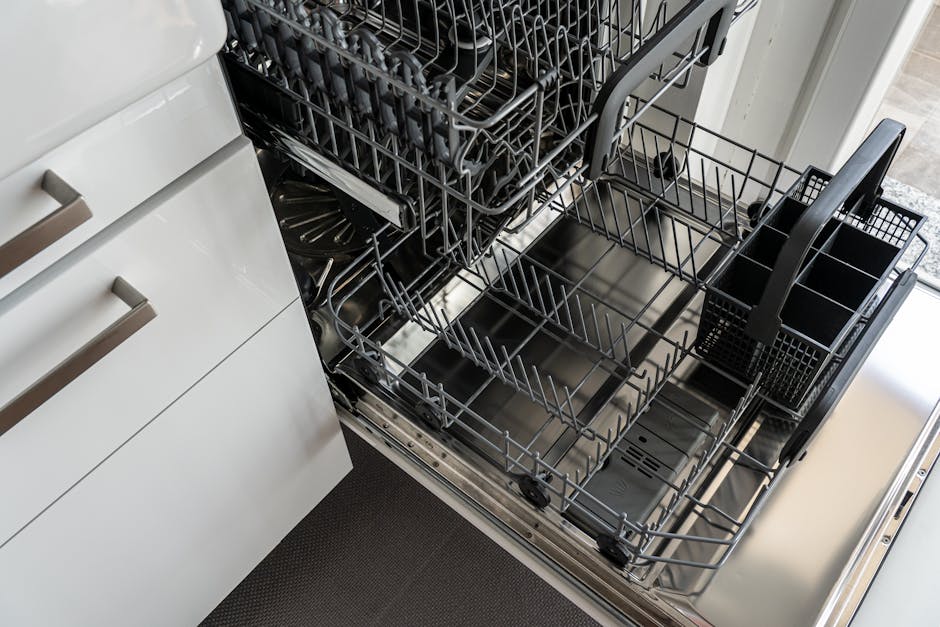
Put the ball right in among the forks and spoons in the cutlery basket, or wedged in the bottom rack directly beside them. The reaction happens through the water, so proximity genuinely matters: a ball rattling around at the far end of the machine does a fraction of the work. What it must never do is touch the heating element at the bottom of the tub, so if your basket sits low, tuck it into a rack corner instead.
Step 3: Add a teaspoon of baking soda to the tub floor
This is the part most versions of this hack leave out, and without it you'll be unimpressed. Sprinkle a teaspoon of baking soda across the floor of the dishwasher before you start the cycle, on top of your normal detergent in its dispenser. Modern detergents are far less alkaline than they used to be since phosphates got removed, and this reaction needs alkaline water to run properly. The baking soda is what takes it from "slightly brighter" to "did you buy new forks."

Step 4: Load the cutlery so nothing nests or touches
Spread the pieces out with handles down and separate any silver or silver-plated items from the stainless ones. Spoons that nest inside each other come out with a dull patch exactly where they touched, every time. Keeping silver and stainless from resting against each other matters more than people realize: different metals in contact in hot water can pit each other over time, and that damage doesn't buff out. Give everything its own slot.
My Expert Tip: Never run this cycle with any aluminum cookware in the machine: no aluminum pans, no anodized pots, no moka pot parts. The reaction that pulls sulfur off your silver is perfectly happy to attack aluminum from the other direction, and you'll pull out a baking sheet that's gone chalky, gray, and permanently pitted. Foil ball in, aluminum cookware out, no exceptions. I found this out with a $45 anodized pan that now lives in a cupboard I don't open.
Step 5: Run the hottest cycle you've got
Choose the hottest wash your machine offers and skip any rinse aid for this load. Heat is the accelerator: the same load on eco mode at 50°C does maybe a third as much. If your dishwasher has a sanitize or intensive setting, that's the one. And use a detergent without added bleach for this cycle; bleach and aluminum in hot water is a combination that produces a smell you won't enjoy and does nothing useful for your forks.

Step 6: Dry everything by hand the second it's done
Open the door as soon as the cycle ends and dry each piece with a soft cloth while it's still warm. Air-drying is what puts the water spots back on, and you've just spent a whole cycle removing them. Warm metal dries instantly with almost no effort: thirty seconds for a whole basket. Throw the used foil ball away; it'll have gone dull gray where it absorbed the sulfur, and a spent ball does nothing on the next run. Fresh ball every time, which costs about nine cents.

Where this leaves me
Forty minutes of hand polishing and a $12 tube replaced by one sheet of foil and a teaspoon of baking soda: call it nine cents and no effort at all, because the machine was running anyway. I do it every few weeks now instead of twice a year in a panic, and my aunt's flatware has stayed bright for three years without a single polish, which means three years of not sanding silver off it.
Two things I'd flag before you try it. Don't do this with antique silver, hollow-handled knives, or anything with a cemented handle or a decorative patina: the heat can loosen the filler in hollow handles, and deliberately darkened detailing will come out looking flat and wrong. Those still want a hand polish. And if your plated cutlery is worn down to the base metal in spots, this won't rescue those patches; nothing will except replating.
Everything else, everyday stainless, silver-plate, the mismatched spoons in the back of the drawer, comes out looking like it did in the shop.
Go open your cutlery drawer and tilt a spoon toward the light. If it's gone gray in the grooves, hit the share buttons below and send this to whoever in your family still owns the good silver.